CPR and First Aid Certification for New Parents: Where and How

Most parents spend weeks researching strollers and car seats before their baby arrives. Far fewer spend two hours learning what to do if their baby stops breathing. That gap matters more than almost any product decision you’ll make.
Infant CPR and first aid certification is one of the most concrete things you can do to prepare for a real emergency. Not because emergencies are likely, but because when they happen, they happen fast, they happen at home, and they happen when you are the only person there.
Why Infant-Specific Training Is Different From General CPR
Adult CPR training does not prepare you to help an infant. The techniques are different in ways that matter.
For an infant, you use two fingers rather than the heel of your hand for chest compressions, placed just below the nipple line on the breastbone. Compression depth is about 1.5 inches, roughly one-third of the chest’s depth. For rescue breaths, you cover both the mouth and nose with your mouth and deliver only a small puff of air, just enough to see the chest rise. An adult-sized breath can overinflate infant lungs and cause harm.
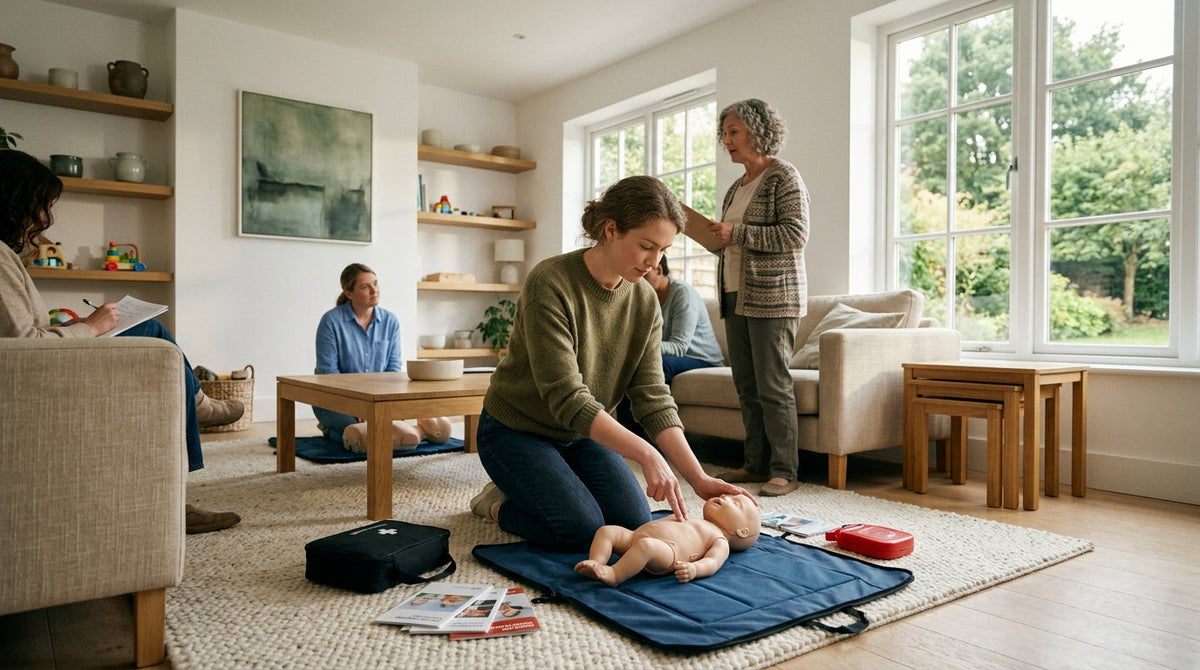
These are not minor adjustments. They require hands-on practice with an infant manikin to develop the right feel, the right pressure, the right rhythm. Reading about them is not the same as doing them under the guidance of an instructor who can correct your hand placement in real time. That’s the core reason infant-specific, in-person training is the standard recommendation from pediatric safety organizations.
Per the American Heart Association, most out-of-hospital cardiac arrests (73.4%) happen in homes or residences, where a family member is often the only potential rescuer. Starting CPR within the first five minutes after cardiac arrest can nearly double a child’s chances of survival. That five-minute window is the reason your own readiness matters more than waiting for paramedics.
Where to Find Infant CPR Certification
The two most recognized certifying bodies in the United States are the American Heart Association and the American Red Cross. Both offer courses that include infant CPR, choking relief, and basic first aid. Both offer in-person and blended formats (online knowledge component followed by an in-person skills session). Both issue cards that are valid for two years.
But you don’t have to go to a commercial training center to get certified. Many hospitals offer infant CPR classes specifically for new parents, often at no cost or very low cost, sometimes as part of a childbirth education series. Pediatric clinics, community centers, and YMCAs frequently run sessions on evenings and weekends to accommodate working families. When my older daughter was born, the hospital where I delivered offered a two-hour infant CPR class the week before my due date. It was free, it was taught by a pediatric nurse, and it was the most useful two hours of my entire third trimester.
When evaluating a course, look for:
- Hands-on practice with infant manikins (not just watching a video)
- Real-time instructor feedback on compression depth and hand placement
- Coverage of both CPR and choking relief for infants
- A certification card issued upon completion
- An AED component, even if brief
If cost is a barrier, call your pediatrician’s office and ask what they recommend locally. Many practices keep a list of free or subsidized options for new parents.


The Choking Component Is Not Optional
Choking is a leading cause of injury and death among children, especially those under age 4. Per the American Academy of Pediatrics, a child dies every 5 days in the United States from choking on food. The CDC reports that more than 12,000 children are treated each year in U.S. emergency departments for choking on food, about 34 children a day.
For infants, choking relief is not the Heimlich maneuver. It’s a specific sequence: five back blows delivered between the shoulder blades with the heel of your hand, followed by five chest thrusts using two fingers on the breastbone. You alternate these until the object is dislodged or the infant loses consciousness, at which point you begin CPR. Getting this sequence wrong, or freezing because you’ve never practiced it, costs time you don’t have.
I learned this the hard way with my younger daughter. She was about nine months old and got hold of a piece of food she shouldn’t have had. She gagged, went quiet, and I had about three seconds of complete terror before she coughed it clear on her own. She was fine. But I remember standing in the kitchen afterward thinking: I knew the steps in my head, and I still wasn’t sure I would have done them right. That’s when I signed up for a refresher course. Knowing the theory is not the same as having the muscle memory.
-
Deliver 5 back blows
Support the infant face-down on your forearm. Strike firmly between the shoulder blades with the heel of your hand. -
Deliver 5 chest thrusts
Flip the infant face-up. Use two fingers on the breastbone, just below the nipple line, and push down firmly. -
Alternate and check
Repeat the cycle, checking the mouth for the object after each set. Never do a blind finger sweep. -
Begin CPR if infant loses consciousness
If the infant becomes unresponsive, place on a firm flat surface and start infant CPR. Call 911 immediately.
Recognizing When to Act
CPR training should include recognition, not just technique. For infants, the signs that require immediate action include:
- Unresponsiveness (no reaction to voice or touch)
- No normal breathing (gasping is not normal breathing)
- Skin that is pale, blue, or mottled, particularly around the lips
- Limpness
The call-or-compress question also matters. If you are alone with an infant who is unresponsive and not breathing, the current guidance is to perform two minutes of CPR first, then call 911. If someone else is present, one person calls while the other begins compressions. If an AED is available, use it as soon as it’s accessible. Your CPR course should walk through this decision tree explicitly, because hesitating to figure it out in the moment costs seconds.
Severe allergic reactions and respiratory distress are also covered in quality infant first aid courses. Knowing the difference between a baby who is breathing noisily and one who is working hard to breathe, or recognizing hives and facial swelling as signs of anaphylaxis, can determine whether you call your pediatrician or call 911.
Online Courses: What They Can and Cannot Do
Online-only CPR courses have expanded significantly, and they have real value for knowledge review. They are not a substitute for certification. Hands-on skill demonstration with an instructor present is necessary for developing the physical competence to perform compressions correctly under stress.
Blended courses, where you complete the knowledge portion online and then attend a short in-person skills session, are a reasonable option if your schedule makes a full in-person class difficult. The skills session still gives you manikin time and instructor feedback. That’s the component that cannot be replicated on a screen.
After you’re certified, skill review videos from the AHA or Red Cross are useful between renewals. Watch them. Run through the steps mentally. But treat them as maintenance, not replacement.
Certification Lasts Two Years. Plan for Renewal.
CPR certification from both the AHA and Red Cross is valid for two years, after which you need to recertify. Mark the expiration date on your calendar when you get your card. Renewal courses are shorter than initial certification, typically 60–90 minutes, because they assume baseline knowledge.
If your card hasn’t expired but it’s been 18 months and you feel uncertain about the steps, take a refresher anyway. The two-year window is a maximum, not a guarantee of retained skill. Parents who haven’t practiced since their initial class often find that the physical mechanics feel less automatic than they expect. A refresher before the card expires is a reasonable choice, especially if you’ve had another child or if your household’s caregiving situation has changed.
Everyone in Your Child’s Life Should Be Certified
Your certification matters. So does your partner’s. So does your mother’s, your nanny’s, and the daycare staff’s.
Per the American Heart Association, most cardiac arrests happen at home, and the person present when an emergency occurs is often not the parent. Grandparents who provide regular care, babysitters who watch your child alone, and any adult who spends significant time with your infant should hold current infant CPR certification. This is not an unreasonable ask. Many hospitals and community centers offer group sessions that make it easy for multiple family members to certify together.
When I was returning to work after my younger daughter was born, I asked my mother-in-law, who was providing childcare two days a week, to take an infant CPR class before she started. She was initially a little surprised by the request. She took the class, and she told me afterward that she was glad I’d asked, because several of the techniques had changed since she’d raised her own children.
The Confidence Factor
Parents who complete infant CPR training consistently report something beyond technical readiness. They feel less anxious about being alone with their baby. That reduction in anxiety is real and meaningful. Knowing you have a plan, and that your hands know what to do, changes how you experience the early months of parenting.
The AAP’s guidance at HealthyChildren.org and the CPSC’s baby safety resources both point parents toward CPR certification as a foundational step in home safety preparation, alongside car seat installation and safe sleep practices. It belongs in the same category: not optional, not something to get around to eventually.
Find a class before your baby arrives if you can. If you’ve already had your baby and haven’t certified yet, find one this month. The Red Cross and AHA both have class locators on their websites. Your hospital or pediatrician’s office can point you to local options. Two hours of your time, practiced with a manikin, guided by an instructor, is what stands between knowing what to do and being able to do it.